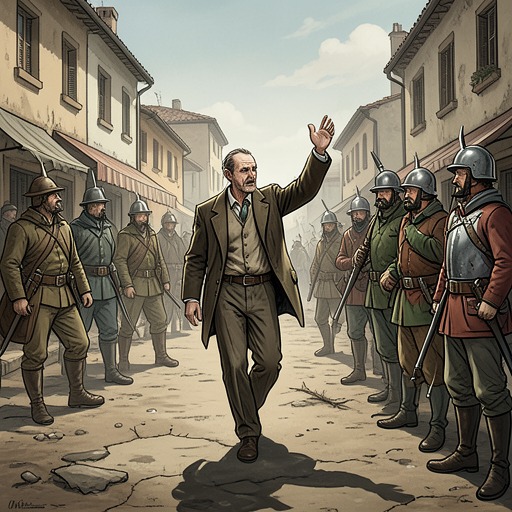
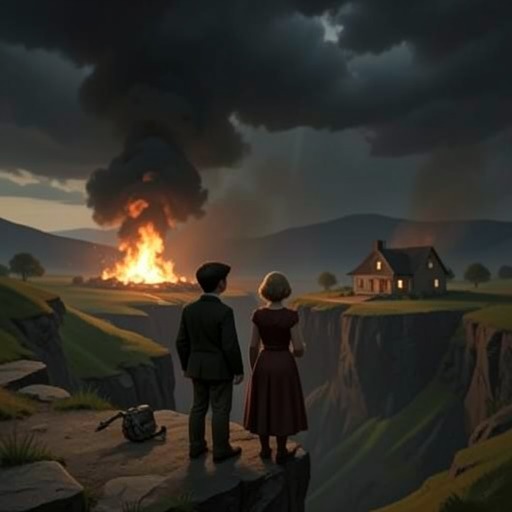
Farbranch Is Attacked by the Prentisstown Army
The Knife of Never Letting GoThe attack on Farbranch turns a warning about pursuing men into the sight of an invading army. For Todd Hewitt and Viola, the change is immediate: the settlement they have reached for shelter is now under armed assault, and its residents are trying to hold the attackers back. The episode exposes the scale of the threat pursuing them while showing that Farbranch's people will not simply hand them over.
Warning and the first response
Francia tells Todd that Prentisstown men are attacking the whole town. Her warning makes the danger larger than a confrontation between the pursuers and the two travelers: Farbranch itself is in the path of the force. Todd's reaction is alarm, and his first thought is that he and Viola must leave. But Francia refuses that course. Because the attackers want Todd, she reasons, Farbranch has reason to keep him from them.
The settlement is already in motion when Todd follows Francia out. Men and women carrying rifles run toward the orchards, while others hurry children into houses. Distant gunfire and shouting signal that the attack is under way across the community, not confined to one meeting or one road. The civilians' actions show both sides of the emergency: some residents are organizing a defense, while others are trying to protect those least able to defend themselves.
Francia tells Todd and Viola to stay inside and not come out, even as Todd argues that they should escape. Her answer is that Farbranch has guns too, and that no Prentisstown posse will take the town. This is a claim of resistance, not proof that the settlement can withstand the assault. At this point, Francia is acting on the apparent scale of the threat: armed pursuers have arrived, but she has not yet seen the force assembled across the valley.
The force revealed
Todd and Viola leave the immediate shelter and climb a hill overlooking the valley. Another burst of gunfire sounds as they reach the top. From there, the disparity becomes visible: Farbranch's residents are running back down the hill in retreat, while mounted men advance over its crest. Rows of armed men follow, five across, behind horses Todd takes to be those of Mayor Prentiss. What had been described as a posse is, in fact, an organized force on a far greater scale.
The numbers make the reversal unmistakable. The attackers are estimated at three times the population of Farbranch, with three times as many guns. As gunshots sound, residents fall back toward their houses. Todd concludes that the town will be taken easily and before the hour is over. The earlier confidence that Farbranch could resist the pursuers gives way to the recognition that it faces an army capable of overwhelming it.
Todd and Viola hide behind bushes, although darkness and the noise of the battle already make them difficult to detect. Their retreat into cover reflects how exposed they have become: the army is across the valley, the settlement is falling back, and the force has come for them as well as for the town. The scale of the assault turns their presence into a danger shared by the people who offered them refuge.
Refuge under attack
The residents' response matters even as it fails to halt the advance. Francia does not treat Todd as someone Farbranch should surrender simply because armed men demand him. She insists that the town's weapons and solidarity give it grounds to resist. The attack tests that commitment against a force with overwhelming numerical and military superiority. The people running toward the orchards and those moving children indoors are not spectators to Todd's flight; they are caught in a collective defense and a struggle to preserve their homes.
The contrast between Francia's expectation and Todd's view from the hill gives the scene its decisive turn. At first, the danger seems limited enough for the settlement to answer with its own guns. The mounted advance and the ranks behind it reveal the attackers' true scale, and the residents' retreat makes the likely outcome plain. The scene therefore marks more than an interruption to Todd and Viola's journey: it shows the cost to a community of sheltering people pursued by Mayor Prentiss's forces.
The wider history of the violence
Later revelations place the attack within a broader history of violence associated with Prentisstown. Ben explains that hardship across New World, including failing crops and sickness, was followed by preaching that blamed the Spackle. That preaching became a movement and then a war. Humans had guns while the Spackle did not, and Ben describes the result as their defeat, though he acknowledges that not all survived victims were killed and that the survivors learned to keep away from men.
The account then turns inward. Todd identifies the killing of Prentisstown's women after the war, and Ben confirms that many men took part under the influence of Mayor Prentiss and Aaron's teaching that what was hidden must be evil. Women and men who tried to protect them were killed. These disclosures do not establish the army's immediate orders at Farbranch, but they deepen the significance of its advance: the attack belongs to a story in which blame and political or religious preaching have helped make organized violence possible.
A later account of Prentisstown's coming-of-age killings reveals how that violence was maintained through public participation. Men who were said to have disappeared had in some cases been executed, with boys made to kill on their thirteenth birthdays; when no escapee was available, an unpopular man could be presented as one who had fled. The resulting system made a victim's death part of a boy's passage into manhood and implicated the watching community. Set beside Farbranch's attempt to defend its residents and protect children, this history sharpens the conflict between the town's collective resistance and the coercive order advancing across the valley.